Safe handling for $1,000,000 on a flatcar
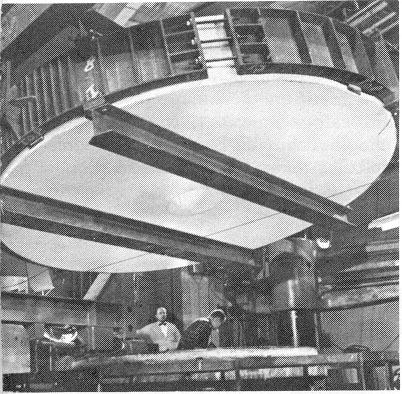
Huge 13-ton mirror for giant telescope is lifted off the grinding table at the Corning Glass Works, in Bradford, Pa.
It was velvet gloves all the way, as PRR people moved a "million-dollar baby" from Johnsonburg, Pa., to Pier 80 in Philadelphia.
The "baby" was 144 inches in diameter, 20 inches thick and weighed 13 tons-all glass. It was the largest piece of fused silica glass ever made.
It was officially identified as a mirror blank, built by Corning Glass Works, Bradford, Pa. Its destination was the Reosc optical firm in Paris, France. There it will undergo two to three years of grinding and polishing.
After that, it will be shipped to Chile, to form part of one of the world's largest telescopes.
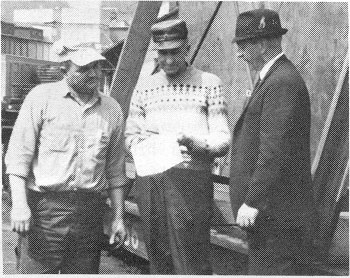
F. J. Faltz (right), supervisor of damage control, watches Car Inspector A. H. Longhi and Conductor J. F. Welsh fill out necessary CT207-1 inspection form.
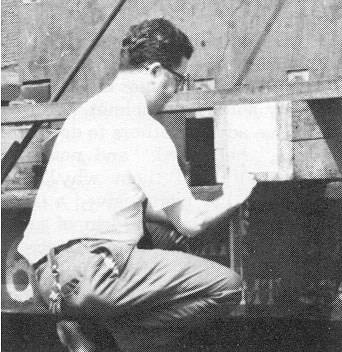
N. J. Bolan, clerk at Johnsonburg, affixes CT314, excessive dimension card.
The big load was delivered to the PRR by the Erie-Lackawanna Railroad at Johnsonburg, on the Northern Division.
It came encased in 1/4-inch armor plate as protection against rock-throwing and BB-gun vandals. It rested on 8x12 timbers to absorb any shock, and the entire load, including supports, was welded to a depressed-center flatcar.
When the shipment arrived on the PRR, Car Inspector A. H. Longhi measured it for clearance. George T . Devlin, supervisor of loading services, and Francis J. Faltz, supervisor of damage control, double-checked the load and arranged to ride with it.
The car was coupled at two miles per hour. It was carried over 341 miles of PRR track at speeds not exceeding 25 mph.
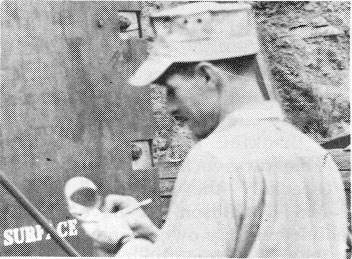
At Ridgway, Pa., Conductor A. R. Tassone adds his signature to the vital CT207-1.
In the yards along the route, the speed was 3 mph. All switching was done with engines attached and air brakes connected.
Joseph E. Eppley, supervisor of damage control, rode with the load from Harrisburg to Philadelphia. At Tidewater Yard, Conductor John E. Bulkey's yard crew was on hand to take over.
"We wanted no mixup with this baby," said Frederick J. Dallas, supervisor of damage control, Philadelphia Division. "The yard crew knew what was coming and how to handle it.
Yardmaster Charles DeCosta was ready, too. Track 11, at the edge of the yard, was cleared and the load was spotted under the window of Trainmaster N. L. Bishop.
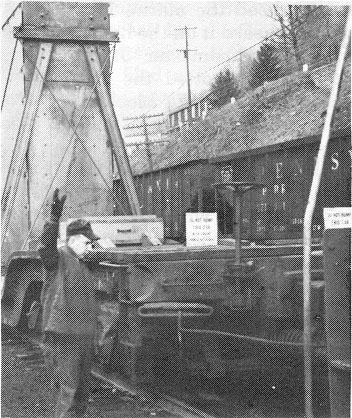
At Renovo, Pa., Brakeman J. B. Carson signals engineman for a gentle coupling.
"We felt better when we could see it," Mr. Bishop explained.
Julius Piroli, track foreman, had both ends of the track spiked so no other cars could run on it. The switch at the head of the track was blocked with a wooden wedge.
For extra safety, the adjacent track was kept clear of cars.
The men at Tidewater watched over the $1,000,000 load for nearly a week till the ocean-going vessel was ready for it.
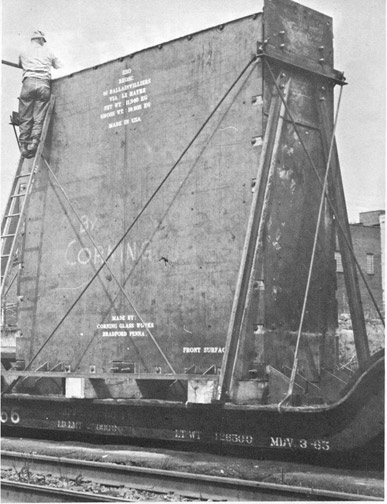
A. H. Longhi, Northern Division car inspector, measures case containing the mirror after the car is delivered to the PRR by the Erie-Lackawanna Railroad at Johnsonburg.
Before moving it to the pier, Conductor Joseph J. Furey's crew, with Engineman William B. Stone at the throttle; made a test run with their switcher along the l/2-mile route, to make sure the track was clear and all switches were working properly.
When they came back, coupled up to the load and started out, they were accompanied, on foot, by Mr. Bishop, Mr. DeCosta, Mr. Dallas and several yard men.
PRR Patrolman Richard Tregmann led the parade, clearing traffic. A PRR emergency truck followed.
The ground escort watched closely as switches were crossed, ready to signal Engineman Stone at the first sign of trouble. A sharp watch also was kept for any close clearance.
"Hold it!" exclaimed Mr. Dallas, as they approached the pier.
Some time between the trial run and the delivery, someone had parked an auto too close to the rails.
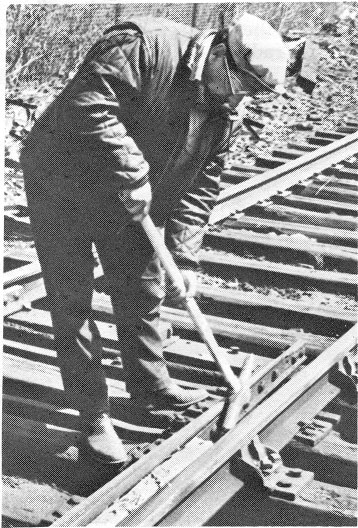
At Philadelphia, yard switch is wedged to block track where mirror is parked.
Unable to find the owner, the PRR men pushed the car several inches to the side.
And then the mirror was at the pier-right on schedule. Brakeman Walt Chryszanowski locked the wheels and Brakeman Charles Chobert chocked them.
Soon the mirror was hoisted aboard the ship. PRR people relaxed after a delicate job well done. For all this, the Railroad collected $541.87.
"Not an awful lot," Mr. Dallas said. "But we showed what a railroad can do. No other form of transportation could have handled it."
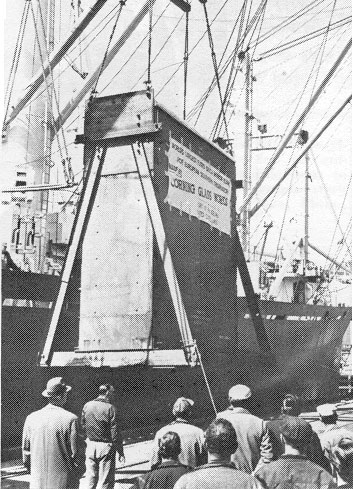
A large sigh as the $1 ,000,000 shipment goes aboard a vessel bound for France.
Eventually, the big glass blank will be the reflecting mirror of a giant 144-inch telescope on La Silla Mountain in Chile.
Completion of the observatory is expected in 1972. It is being constructed jointly by Belgium, France, West Germany, the Netherlands and Sweden. The five nations agreed to establish the observatory in the southern hemisphere because nearly all the world's large telescopes are in the northern hemisphere.
Corning is now fabricating a 152- inch mirror for the Queen Elizabeth II Observatory in Canada. "Someday," said Mr. Dallas, "we may be doing this all over again."
