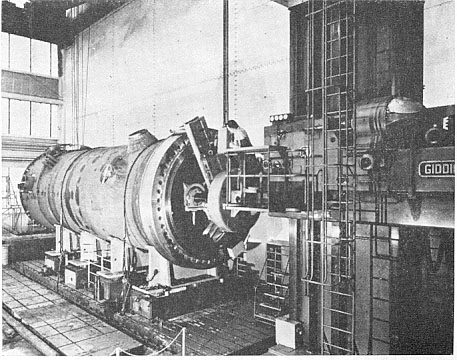
Machining the huge vessel to close tolerances was done on outsize machine tools like this one in the Barberton plant of Babcock & Wilcox. |
 |
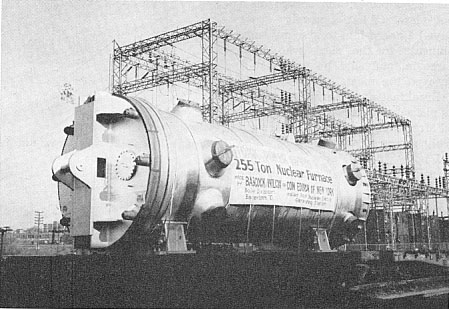
The Erie Railroad's reputation for moving high and wide - and precious - loads with speed, safety, and a minimum of fuss, gained new luster with the movement of a 255-ton nuclear reactor from the Babcock & Wilcox plant at Barberton, Ohio, to Jersey City for the trip up the Hudson to the Indian Point generating station of Consolidated Edison.
Experienced as the Erie is in doing the impossible at a moment's notice, the shipment of the reactor did have some new twists. First of all, there was the question of the time of shipment. Originally scheduled for the weekend of April 30 - May 1, the date was moved up to April 24 - 25 on April 22, giving little time for considering the clearance and weight problems involved.
Machining the huge vessel to close tolerances was done on outsize machine tools like this one in the Barberton plant of Babcock & Wilcox. |
|
First reactor authorized to be built wholly with private funds; it will supply power to customers of Con Edison in the New York City - Westchester area beginning in 1961. Naturally, extensive tests and adjustments have to be made with such a device, and Babcock & Wilcox, when asked to make early delivery if possible, managed to do so, with the help of the Erie.
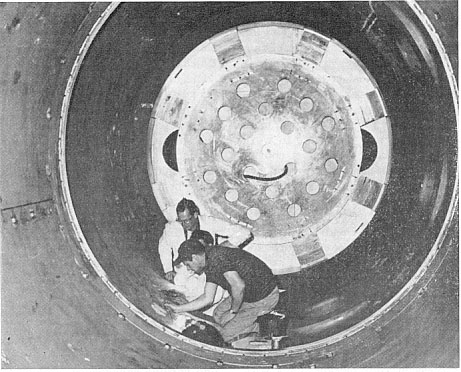
Workmen removed microscopic scratches on the inside of the reactor's seven inch thick walls before it left the Babcock & Wilcox plant. For more than 30 fleet the inside of the reactor had to be accurate to within seven one-thousandths of an inch. |
 |
The huge cylinder that forms the main part of the reactor was loaded aboard a heavy - duty flat car in the B&W plant on the Friday before the move.
During its construction over 9,500 quality control inspections and tests had been made, but after it was loaded, another test was carried out. The tightly sealed vessel was filled with nitrogen under pressure to check for possible leaks. The nitrogen was left in to protect the reactor from the oxygen in the air, and to make certain that no leaks developed in shipment.
Reactor vessel, and its head on a separate car, are checked over at Barberton yard. |
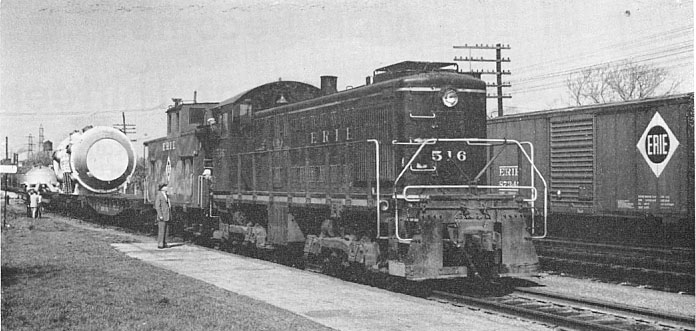 |
Extreme width of the vessel as loaded was 13 feet 7 inches between 11 feet 2 inches and 12 feet 10 inches above top of rail, and it weighed 572,000 pounds. On another flatcar was the head of the vessel - a cap weighing 36 tons, and the huge nuts, bolts' and washers to join the two parts together.
The bolts are no playthings - each weighs 454 pounds, and is six feet long, and five and a half inches thick, silver-plated to prevent corrosion. The nuts are eight inches high and weigh 51 pounds each; and the washers weigh 10 pounds each.
Special studies of the center of gravity of the load were made before it began its movement, as well as the usual checks and rechecks of all clearances and weights permitted throughout the length of its move on the railroad.
Early on Monday morning the shipment moved from the B&W plant to Barberton yard, where it arrived at 8:15 a.m. of the 25th. Thence it went eastward over the railroad, under constant observation by rail and B&W officials who rode in a special caboose just ahead of the loaded car.
At the Erie's Marine Yard in Jersey City the reactor was loaded aboard a barge for the trip up-river to Indian Point. |
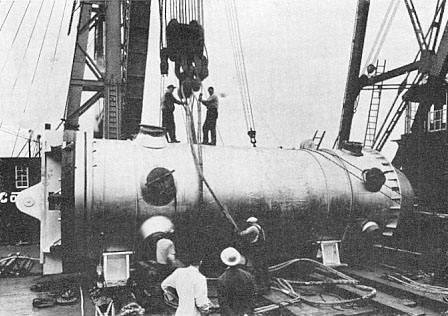 |
At 5:40 p.m. the next day the load was at Jersey City; the next afternoon it was lifted from the car at Pier 1 of the Erie's Jersey City marine yard, and placed aboard the heavy capacity derrick barge Catskill for the trip up the Hudson.
The lift was made by the Merritt - Chapman & Scott Corp.'s floating derrick Monarch, said to be the world's largest floating crane.
The Catskill carried the vessel up - river 24 miles to Indian Point, where the Monarch lifted the vessel off and placed it aboard a special rubber - tired vehicle for movement to the spot near the river's edge where the reactor will be erected.
Before moving east the reactor vessel posed for a full - Iength portrait on the Erie. |
 |
For the Erie the movement was not distinguished so much by its size - as for its weight and value. The railroad had moved larger objects - even though its size made it very much an Erie-sized package.
When the Indian Point station goes into operation next year it will have a total output of 275,000 kilowatts, of which 163,000 will be provided by the atomic system, and the balance of 112,000 kilowatts by more conventional oil-fired super-heaters.
Fuel for the reactor will be unusual in that it will be the first American one to make use of Thoriurn as a material to stretch the useful life of the base fuel, Uranium 235.
