This article is from the May June 1958 issues of "Nickle Plate Road Magazine.
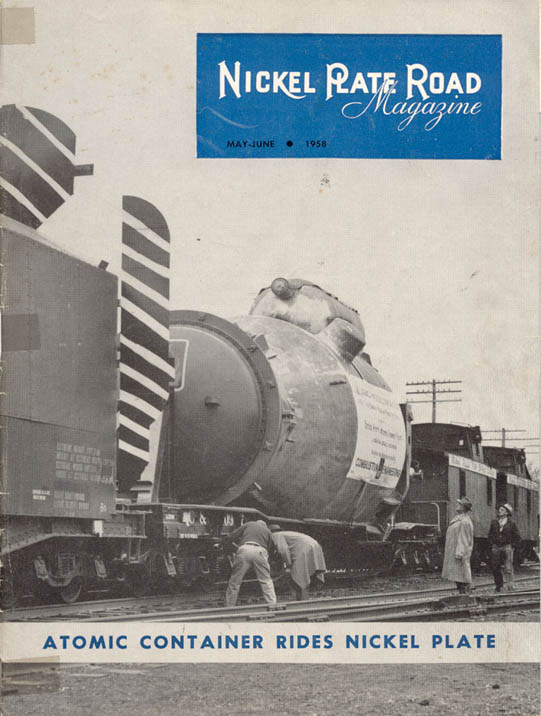
During the rainy, overcast weekend of April 26-28, the Nickel Plate handled "the highest and widest load ever moved by rail" for 165 miles through Indiana.
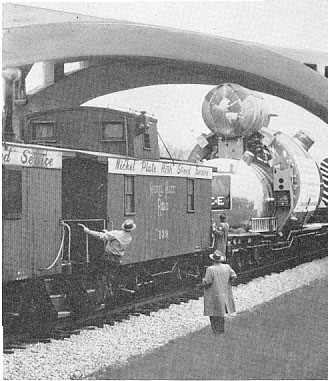
Atomic container is eased under the T. H. I. & E. viaduct near Foley, Ind. Checking clearances are: F. J. McGuirk, R. F. Miller and Supt. Roy Clear. |
 |
A huge, 91-ton steel vessel - the reactor container for an atomic power plant - was moved from Rushville to Muncie, and from Marion, through Kokomo, to Belfast.
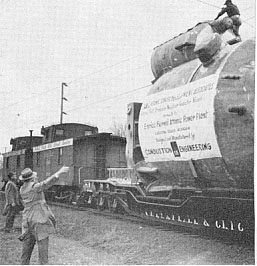
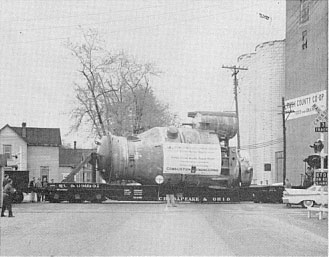
Loaded, the atomic reactor vessel extended 21 feet, 4 inches above the rail - 5 1/2 feet taller than an S - type locomotive. Its maximum width was 14 feet 11 3/4 inches, three times the gauge of track.
Nickel Plate "special" handling atomic container is pictured north of Argos, Ind. A "pilot car," one inch higher and inch wider than load, moved in front of load. Train was operated only in daylight, at maximum of 15 miles per hour. |
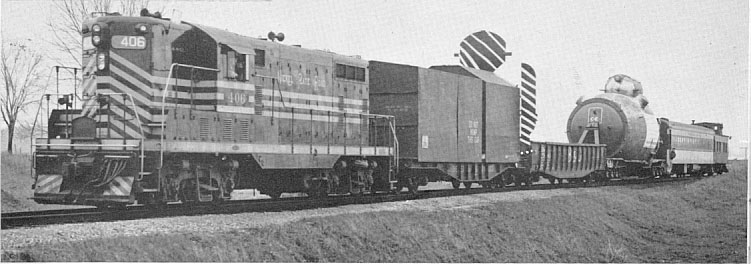 |
Planning for the shipment began in September 1955. Bridge, trestle and underpass clearances were checked throughout the route. Tree limbs, wires and telephone cables were cleared. To guard against unforeseeable problems, a "pilot car" one-inch higher and wider than the load moved immediately in front of the vessel - carrying flatcar.
Patrolman William Poynter was assigned to shipment from Rushville to Kokomo. 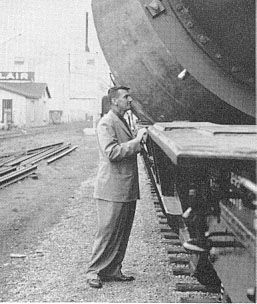 |
Special four-page operating instructions specified that the train could move only in daylight at a maximum speed of 15 miles per hour. The train could not pass or be passed by any equipment on adjacent tracks. When parked overnight at Peru, the entire train was placed on the spur track west of the yard office. Switches were spiked. Police stood guard throughout the night.
|
Harry Summers and E. D. Walsh direct train crew as wires were lifted over load. |
 |
Nickel Plate's movement was a middle lap in a 1,598-mile journey from Chattanooga, Tenn., where the container was built, to the site of the Enrico Fermi Atomic Power Plant on Lake Erie at Lagoona Beach, Mich., 30 miles south of Detroit.
Crossing Watchman Earl Cameron flags at Rushville. |
 |
The vessel was moved by barge from Chattanooga down the Tennessee River to Paducah, Ky., and then up the Ohio River to Cincinnati. There it was transferred to a heavy-duty flat car, which had been modified to carry the vessel. Five railroads handled the shipment on its 670-mile rail journey.
