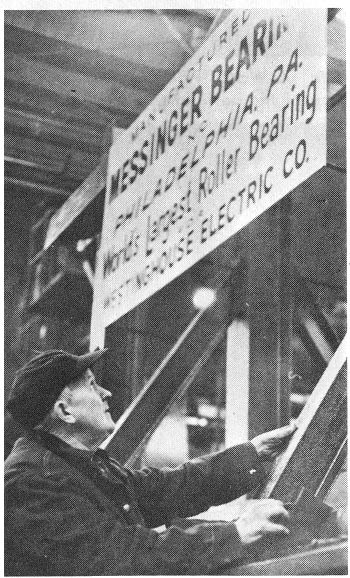
Car Inspector James J. Coyle, of Frankford Junction, checks the steel bracing. |
 |
"It looked like the biggest hula hoop you could imagine," recalls Edward Ingersoll, gang foreman at Frankford Junction freight yard in Philadelphia.
Car Inspector James J. Coyle, of Frankford Junction, checks the steel bracing. |
|
Actually, it was the largest roller bearing ever made: just over 15 feet in diameter and weighing 22,000 pounds.
It was manufactured by Messinger Bearings, Inc., and Mr. Ingersoll, aided by Car Inspector James J. Coyle, advised Messinger workers on how to load the huge bearing on one of the PRR's F -33 well cars.
The bearing was mounted on an I beam, then bolted and blocked into place.
The PRR moved it to East St. Louis. Its final destination was the Westinghouse Electric Corporation facility at Sunnyvale, Calif., where the firm is completing a radio telescope for the California Institute 0f Technology.
"It was an extremely rush shipment," Mr. Ingersoll says. "But at the same time we had to be especially careful not to jolt it. As big as it was, it was also very delicate."
The bearing was a key element of the telescope project. Any damage in transit could mean that the construction schedule would be held up as much as six months, said Charles B. B. Penrose, PRR assistant super- visor of clearance.
Mr. Penrose drew up the routing plan. First, he specified that coupling speed should not exceed 2 miles per hour. Secondly, he directed that the loaded car be placed next to the engine, to minimize slack action, which could possibly shift the load.
A final check is given before the world's largest roller bearing moves out on the PRR. |
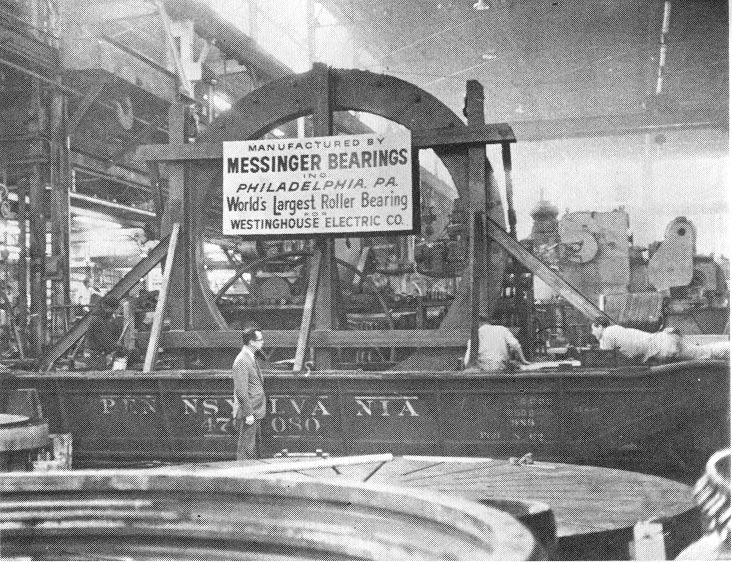 |
If the load had been put on an ordinary flat car, it would have towered 19 feet 10 inches above the rails-too high to clear all points on its journey.
The well car, with its center depression in which the circular load rested, brought the overall height down by two feet.
Even so, the routing had to be custom-tailored to clear certain close spots. For example, moving westward through Philadelphia, the train had to use an eastbound track at one place. The load wouldn't have safely cleared the overhead power lines on the normally used west-bound track.
At Gallitzin Tunnel, it ran on Track 3 instead of 4, because the latter was too close to the tunnel wall to give adequate head room.
For safe routing across the PRR's Central and Western Regions, two other clearance supervisors were consulted-Leroy P. Kettren, at Pittsburgh, and Andrew L. Salapatek, at Chicago.
Eleven days after the load left Frankford Junction, a telegram came from Westinghouse in California to the PRR: MESSINGER BEARING ARRIVED SUNNYVALE IN APPARENTLY EXCELLENT CONDITION. MANY THANKS FOR YOUR HELP.
