V. W. Patti starts F-38 over Eastern Division with its first load, a 448,400 - pound casting |
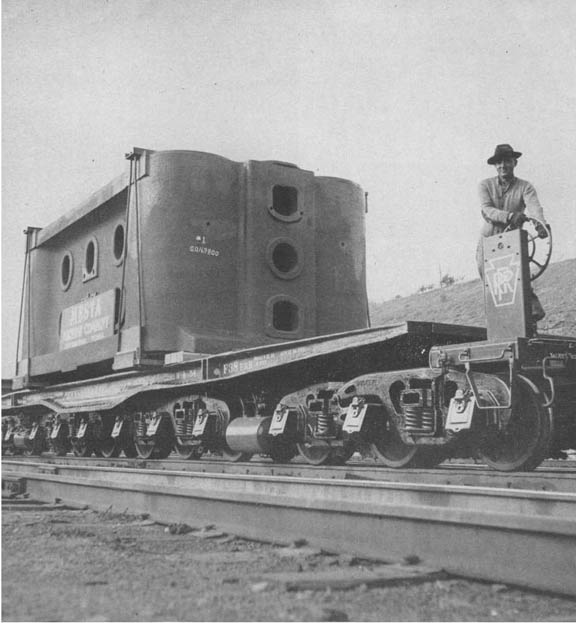 |
The PRR's new F38 flatcar is nothing mammoth. Its overall length is only 51 feet, just 5 1/2 feet longer than an ordinary flat. It stands only 6 5/8 inches higher. Its body doesn't look any thicker, at a casual glance.
But it's the mightiest car on American rails. Its load limit is well over a half million pounds - more than four times as much as much as for all average flatcar.
V. W. Patti starts F-38 over Eastern Division with its first load, a 448,400 - pound casting |
|
By packing all that strength into its modest hulk, PRR engineers have placed the Railroad in a better position than ever to handle industry's heaviest loads with a minimum of clearance and weight restriction problems.
Bernard H, Trostle, Altoona Car Shop painter - felt a bit awed when he stenciled the load limits on the two F38's that were completed last April. The figures were 586,100 pounds for one car, 587,500 pounds for the other.
The cars thus surpass the previous Ieaders among level-deck flatcars -- a New York Central Car with a load limit of 501,300, and a Delaware & Hudson car with a limit of 500,300. They also surpass the Pennsylvania's own FD2, a depressed-deck car with a limit of 503,600 pounds.
The need for the F38 became apparent a year ago. There has been a constant increase in the size and weight of turbines, transformers, presses, and other machinery which American manufacturers have been making and shipping. Again and again recent loads have approached the 500,000 pound mark.
The FD2 has been handling such loads; but there are places where the FD2 can't go, some PRR branch lines and some connecting railroads have spots where the track curvature is too small for the FD2's length - 124 feet - and have bridges considered not strong enough to bear safely its weight 500,400 pounds - plus load.
That's why the operating and traffic department asked for a new car that would be smaller and lighter yet carry as much.
Their request came to Mechanical C. K. Steins, who assigned the problem to his research group, headed by his assistant G. H. Newcomer and including W. B. Porter, L. M. Showers, C. T. Biscardi and R. H. Smith.
The design job involved a constant battle against pounds and inches. One could have designed a heavy-duty flatcar by taking the plans for an ordinary flat and increasing all the measurements: but that would have produced a car too high and too heavy, Mr. Newcomer and his associates developed a wholly new design.. They used hollow "waffle sections" of steel to lighten the body, and tough, expensive, high strength, low alloy steel for the supporting bolsters in order to have slimmer beams without sacrificing strength. To spread the weight on the rail, they gave each car four six-wheel trucks, a total of 24 wheels compared with the eight wheels of an ordinary flat.
The car bodies and truck parts were cast by commercial firms, and the cars were assembled by the men of freight Shop Number 2 Altoona Works. The final weight was 165,500 pounds for one car, 166,900 for the other - approximately one third the weight of the FU2, which, of course, remains indispensable for loads that are extra - high as well as extra - heavy.
With the two F38's, the PRR now has 235 heavy - duty and special designed flatcars for the service of industry - the largest fleet of its kind in the country. It constitutes fully 40 percent of all such cars on American rails..
J. Maurice Ansman, System supervisor of car distribution, says comfortable: "We're ready to take on virtually anything industry wants to toss at us."
