
|
|
|
If it's a giant load of tremendous weight, call on a broad-shouldered, big-muscled railroad to move it.
Call on Southern.
That's what two shippers in Birmingham, Ala., did recently when it came to moving their outsized, ponderous freight.
The two Birmingham shippers are Ingalls Iron Works Company and Robbins Machinery Company.
The largest single girder ever shipped by Ingalls Iron Works Company, Birmingham, Ala., dwarfs Southern Commercial Agent R. R. Campbell. The single girder, 110 feet long - one of three In a recent shipment over Southern weighed 198,375 pounds. |
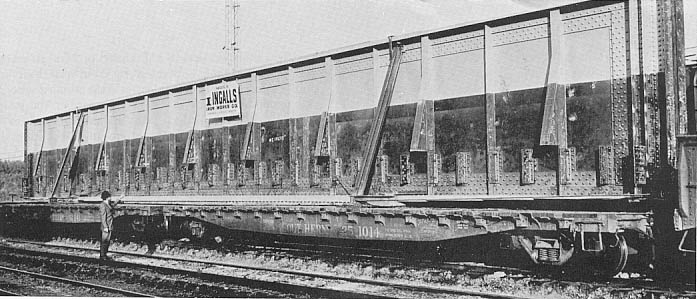 |
Ingalls' shipment consisted of three steel girders weighing a total of 445,375 pounds.
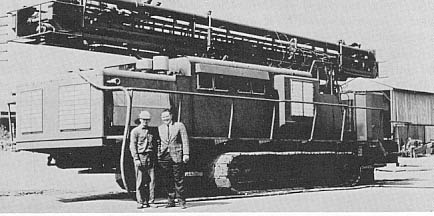
Robbins' shipment consisted of a 160,000 - pound, tractor-mounted rotary drill for the mining of copper.
The two shipments went in different directions, but the point is:
Both went by Southern.
Not that outsized, heavy loads moving via Southern are unusual in Birmingham; there, local residents say, "everything is steel." Massiveness is characteristic of much of the freight outbound from Birmingham.
Operational ingenuity and careful consideration of en route clearances are matters of routine in Southern's Birmingham offices.
However . . .
The Robbins drill which Southern carried to Memphis Tenn., for transshipment to Utah is believed to be the largest vertical drill ever built in the South;
And one of the steel girders which Southern carried to Alexandria, Va., for transshipment to Hicksville, N. Y., is the heaviest single girder shipped by Ingalls in its 53-year history.
Just three steel girders shipped by Ingall's from Birmingham via Southern Railway weighed nearly a half-million pounds. The girders will be used in construction of a New York highway bridge. |
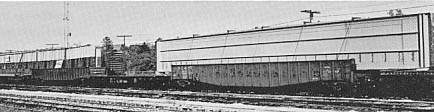 |
The single girder alone -110 feet long - weighed 198,375 pounds,
Another of the three girders weighed 161,000 pounds. The third girder in the shipment weighed "only" 86,000 pounds.
Altogether, nearly a half-million pounds of steel which the William F. Hegarty Construction Company will use for a highway bridge in New York State.
The 525-horsepower rotary drill designed and built entirely in Robbins' shop over a period of six months - will be used by Kennecott Copper Corporation in mining operations throughout Utah. The drill can exert a pressure of 100,000 pounds on the bit and can bore a hole of up to 17 inches in diameter.
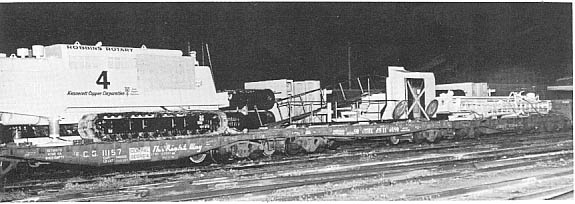
The Robbins rotary drill was loaded over three cars. It is so constructed that it can be easily disassembled for shipment and then reassembled within 72 hours after arrival at destination.
The job of getting such freight to destination is the sort of red meat a hea.thy railroad like Southern thrives on.
Take Ingalls Iron Works, for instance.
Ingalls is in the business of fabricating giant steel parts such as make up the supporting skeleton of America's industrial might; so getting its freight safely from "here" to "there" means coping with load and clearance problems that must be solved.
Since such massive shipments as the half-million pound one to Hicksville, N. Y ., can move best by rail, it follows, then, that Ingalls must use the railroad that can best meet its needs.
Designed and built by Robbins Mach any, Birmingham, Ala., this rotary drill is believed to be the largest fabricated in the South. Kennecott Corporation will use the drill in operations throughout Utah. This photograph was taken before the drill was disassembled for shipment from Birmingham via Southern Railway. The men in the photo are Jack Blalock of Robbins on the left and Houston Phillips, sales manger for Robbins Machinery, on the right. |
 |
That's where Southern enters the picture.
Whether it's up the new, wide-open CNO&TP division into the Middlewest or across the rolling piedmont which Southern traverses on its mainline climb toward the industrial East. ..whether it is south from Birmingham toward Mobile or New Orleans, or by way of Atlanta into southern Georgia or into Florida . . . whether it is along the stair-step route from Birmingham toward Memphis . .. the shipper names his direction, gives Southern his freight ...
And Southern gets it where it's supposed to go, safely, dependably and in ways designed to reduce the shipper's total cost of transportation.
It would have to be a might . . . big and unwieldy piece of freight indeed that would be stopped by clearance or load problems on today's Southern.
The management of Robbins Machinery Company is well aware of this.
Comments N. O. Lewis, chief engineer for Robbins: "We know that we can depend on Southern Railway regardless of the size of the shipment."
This Robbins rotary drill was disassembled for shipment and was reassembled within 72 hours after arrival at destination. This picture was made as the three cars carrying the drill passed through Memphis, Tenn. |
 |
At the present time, a horizontal dual-mast drill, which will weigh some 250,000 pounds, is being built at Robbins' Birmingham shop for the Pittsburgh & Midway Coal Mining Company. That piece of machinery will require five railroad cars for shipment via Southern, and indications now are that the freight will travel without restriction up Southern's high, wide and handsome CNO&TP division.
"The Robbins engineers work in close cooperation with Southern Railway," says Chief Engineer Lewis, "designing their machines for maximum-size shipments permitting a minimum of disassembly and field erection. The Southern Railway System has handled many shipments for us. The service has been competent and dependable. Cooperation has never been lacking."
Competent and dependable service . . . cooperation that is never lacking.
Some of the elements that keep freight moving profitably over Southern Railway, hence some of the elements that make for jobs on Southern.
Because: Jobs Follow the Freight!
