Southern Fits a Car to the Freight
When The Freight Won't Fit The Car ...
Cutting a freight car in' half may not sound like a very good way to run a railroad. But that's precisely what Southern did recently in order to meet the shipping needs of a customer.
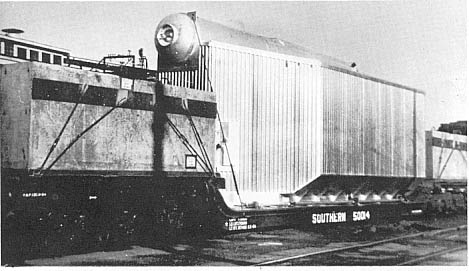
The customer was Combustion Engineering, Inc., an international company with headquarters in Windsor, Conn. Its shipping need centered on a boiler manufactured at the company's Southern-served Chattanooga, Tenn., plant. The boiler weighed more than 120,000 pounds, and its length was more than a third over the 21-foot-long load-carrying area of a standard depressed-center flatcar.
In addition, the huge boiler was designed in such a manner that most of Its tremendous weight was located on one side, creating a serious problem of balance for shipment.
Both Southern and Combustion Engineering constantly work toward finding new ways in which shippers and carriers working separately and together -can find new ways to increase the efficiency and lower the total cost of transportation. Shown here are officers of both companies as Combustion Engineering climaxed a recent three-day transportation seminar in Chattanooga, Tenn., with a tour of Southern's Citico Yards.
|

|
To meet the length requirements, a standard depressed-center flatcar was cut into two parts, and a 14-foot section was "spliced" into it, increasing the load-carrying length of the depressed center section of the car .
Working together, experts from Combustion Engineering and Southern's Customer Service Engineering Section next had to cope with the problem of balance. The answer: Two movable 15-ton concrete blocks that could be shifted about on the car to perfectly balance the boiler during shipment.
"This is only one example of how Southern continues to increase its usefulness to its customers," L. L. Waters, director of the railway's Customer Service Engineering Section, said of the manner in which this unique transportation problem was worked out through cooperation between shipper and carrier.
In a speech opening a recent transportation seminar for Combustion Engineering's officers, which included a tour of Southern's Citico Yards in Chattanooga, the philosophy behind shipper-carrier cooperation in the search for new ways to do a transportation job better was summarized by J. Robert Morton, manager of transportation for Combustion Engineering.
He said: "The techniques, new thinking, new ways which I am hopeful will come out of this seminar are to help you take advantage of the tremendous latent wealth of ideas that are stored in the backs of our minds.." .
The first of Combustion Engineering's newly-developed boilers waits to be shipped from the company's Chattanooga, Tenn., plant on this specially-designed Southern 'Railway flatcar. Weighing 120,360 pounds, the boiler's design made it necessary to install two 30,000 pound concrete blocks like the one shown in the foreground to counterbalance the boiler's tremendous off-center weight.
|
|