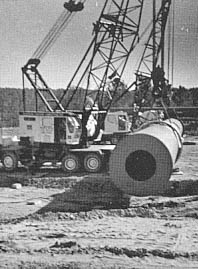
Huge mobile cranes move a rotary kiln into place at the new Andersonville (Ga.) plant of Mullite Company of America. The kiln, used for processing kaolin clay, is one of two to be installed. |
 |
Without railroads, many of the new plants now being built in the South would have a difficult, and sometime impossible, task in trying to get into production. Certainly, without the assurance that railroads could handle difficult transportation -jobs, the planning for plant locations and the equipping of these plants would have to be radically changed.
Southern recently has had a hand in seeing that two important new plants could carry out plans involving the movement of unusually large shipments of production machinery. They were for a new plant of General Electric Company at Ladson, S. C., and Mullite Company of America's kaolin processing plant at Andersonville, Ga.
Huge mobile cranes move a rotary kiln into place at the new Andersonville (Ga.) plant of Mullite Company of America. The kiln, used for processing kaolin clay, is one of two to be installed. |
|
Here's how the News & Courier in Charleston, S. C., told the story of the heaviest load ever moved through that port. Southern did the rest of the job as the pictures show.
"The heaviest piece of cargo ever handled at Charleston port has presented a weighty problem to waterfront and railroad personnel.
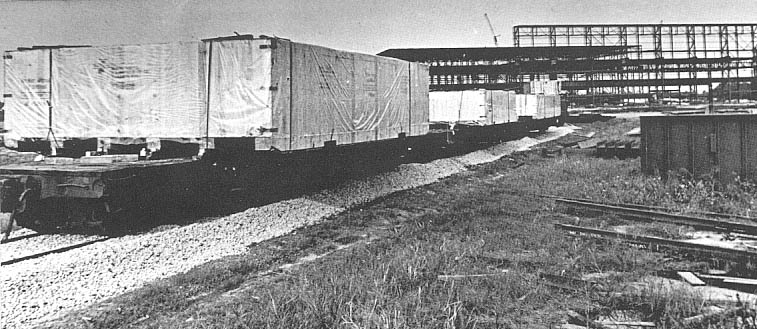
The heaviest piece of cargo (foreground) ever handled at the port of Charleston, S. C., waits to be unloaded from its flatcar at the under-construction plant of General Electric Company at Ladson, S. C. |
 |
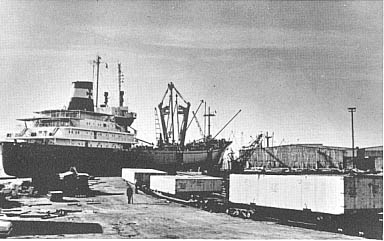
"The German heavy-lift freighter Crostafels worked overnight Sunday to discharge a batch of machinery for the General Electric plant now building at Ladson, near Summerville.
Shoreside cranes were unable to offload the largest piece of equipment-a huge machine for drilling, boring and milling the steam turbine casings and hoods GB will produce here. The crated machine weighed 110 tons.
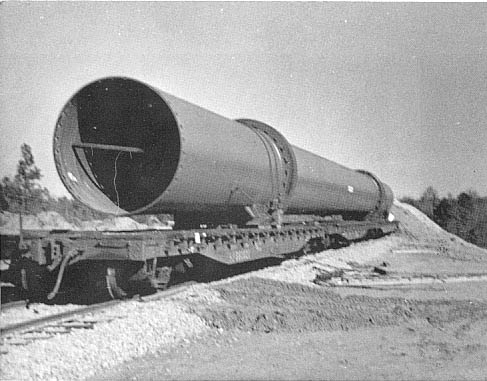
The rotary kiln measured 150 feet long and 8 feet in diameter and required three flatcars for its movement over Southern from Cincinnati, Ohio, to Andersonville. |
 |
"But the Crostafels, one of a fleet of vessels operated by Hansa Line of Germany, was equipped with heavy lift gear capable of raising loads up to 150 tons.
" As the heavy boom swung the item of cargo ashore onto a rail flatcar, the ship took on a heavy list.
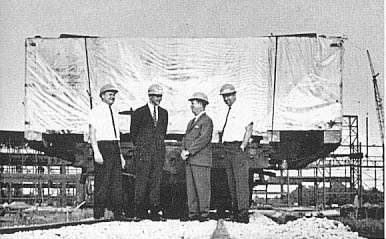
Inspecting the 110-ton, 19-foot wide load of machinery at General Electric's Ladson plant site are (from left) Ralph Johnson, manager-Materials, General Electric; Herbert J. Scholtz, general manager, General Electric; Forrest Von Canon, Southern's district sales manager at Charleston; and Russell Palazzola, traffic manager, General Electric. |
 |
"The 110-ton tool, which will be the heaviest single piece of equipment to be installed at the GB plant was manufactured in Milan and loaded at Genoa, Italy.
"The machine was firmly secured to the rail car yesterday, but other problems are faced in transporting it the 10 miles to Ladson.
Dockside cranes were unable to handle the unloading of the 110-ton box of machinery because of its great weight, so the ship's lift gear, capable of lifting up to 150 tons, was used to load the cargo directly onto the flatcar for movement to the General Electric plant site. Other flatcars carried smaller boxes of machinery. |
 |
The 34-foot long, 18 ft. 8 inches-wide tool is an unusual 'wide load' for Southern Railway Co.
" 'Before it moves out Wednesday, we'll have to remove part of the terminal security fence to allow it through,' Benson B. Brooke, general sales manager of the ports authority, said yesterday. Several pine trees have been cut down along the route."
Mullite needed to have a rotary kiln moved from its point of manufacture in Milwaukee, Wisc. Southern took over the railroad movement at Cincinnati, Ohio, carrying the 150-foot-long unit, 8 feet in diameter, to destination at Andersonville. Another similar unit is to follow. With the plant in full operation, 300 tons per day of calcined clay will be produced.
