Neither Rain, nor snow, nor sleet
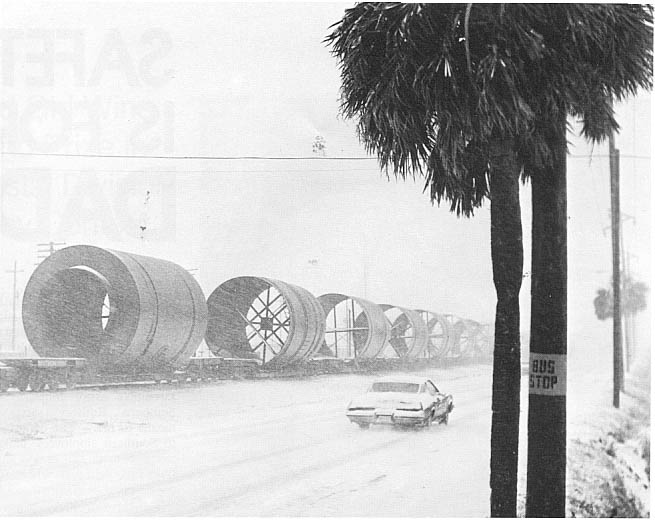
South Carolina's paralyzing snow, dubbed the "Storm of the Century" by residents, created a dramatic backdrop for this jumbo ship- ment. Since 1783 when Charleston began keeping weather records, nothing has been tabulated that compares with the February 11 blizzard.
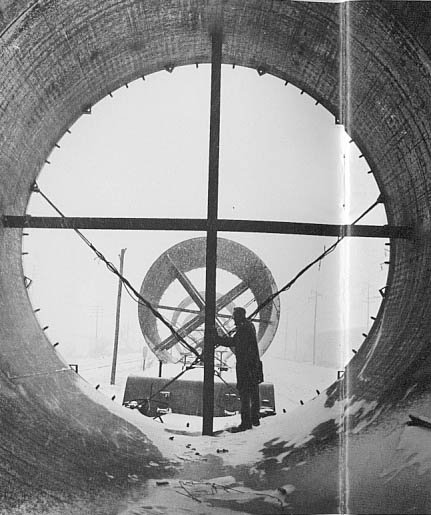
A record seven inches of white stuff fell on Charleston, where Southern Railway picked up a 580-foot-long kiln. Sectionalized in 16 pieces plus riding rings, the kiln is the largest load Southern has carried in terms of height, width and distance moved.
When Southern staff photographer Howard Olmsted took the above picture, he wanted a
person in it to give TIES readers a better idea of the size of the kiln. It was so
cold, however, that nobody was around. So Howard rested his camera on the far end of the
kiln section. Then he set the self-timer that delays the opening of the shutter,
fired the shutter release button and jumped into the picture before the shutter opened.
|

|
Southern moved the shipment 45 miles, from Three Mile Post outside Charleston, to
Giant, S. C. It took seven hours and 26 cars, 11 of which were heavy duty or
depressed center flat cars.
Southern made special arrangements for the journey. Track was lowered at an overhead
bridge and realigned at another. Track was moved away from piggyback facilities.
Obstructions were moved, including 55 poles and numerous signs, signals and cross bucks.
The jumbo rings measure up to 23 feet 3 inches in diameter. They fit together to form a
long tapered rotating tube, used to make cement. Built by Allis- Chalmers in Milwaukee,
the kiln was bound for Santee Portland Cement Company, Holly Hill, S. C.
|
|
Considering its size, the kiln pieces were relatively light-the heaviest car weighed
373,000 pounds-so no bridge reinforcement was necessary.
Plans for the high-wide shipment started nearly two years ago when Allis-Chalmers asked
Southern about the feasibility of the move. A field survey, cost estimates, bidding and
construction followed.
The giant rings traveled by barge from Milwaukee down the Mississippi to the Gulf and
around Florida to the Charleston port.
Seaboard Coast Line picked up the kiln at the port and moved it to Three Mile Post.
Then, Southern took it on to Giant and Seaboard moved it the final three miles.