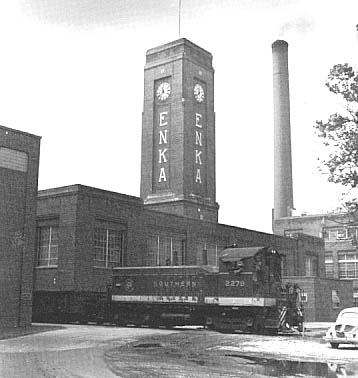
Symbolic of the close working relationship between American Enka and the Southern Railway, a switch engine passes beneath Enka's clock tower at Asheville, N. C., as it spots cars. |
 |
It was there in the newspaper.
And, as they read the Sunday paper for September 23, 1928, the people of Asheville, N. C., sensed that a great and welcome change had come in their region's economic outlook.
A firm called American Enka Corporation was announcing plans for the construction of a rayon manufacturing plant on 2,000 acres of ground next to Southern Railway's "Murphy Branch" in Hominy Valley seven miles from town.
Symbolic of the close working relationship between American Enka and the Southern Railway, a switch engine passes beneath Enka's clock tower at Asheville, N. C., as it spots cars. |
|
The $16 million which would be invested in the project was to mean more than merely fresh money' circulating through the financial veins of that western North Carolina mountain town.
The investment was the town's deliverance from those forces, which were then preparing the United States for the depression.
One of these forces was the collapse of property values. From the coastal Hats of Florida to the high reaches of the Carolina Blue Ridge, land speculators were toppling from the heights of artificial boom, tumbling into the valley of bust.
Their fall echoed with particular fearsomeness about the mountains around Asheville, a non-industrial resort area with an economy wedded to real estate and the attractions which the land about held out to\tourists and vacation-time residents.
Things began changing in Asheville.
Initially, there would be construction workers' wages spent locally, materials bought locally, all of the many local exchanges of a single dollar bill multiplied 16 million times.
And in the years to come, there would be a huge industry offering permanent employment for many and offering proof through its own demonstrated success that would attract more industries to the same area.
It was as though a great hand had dropped a huge stone into a quiet pool. After the first splash, the circles of consequence began radiating confidently outwards. They have not stopped yet.
"Glauber salt," a by-product of rayon manufacture, Ieaves American Enka in these Southern hopper cars for delivery to paper mills and detergent makers. |
 |
When Enka came to Hominy Valley, public comment dealt but briefly with the "why's," dwelled fondly on the outlook.
The Chamber of Commerce president predicted that the location of the plant near the city would "call the attention of the industry world to the idea that Asheville and western North Carolina should be considered by any and all plants contemplating a change in location. I am sure that this is only the beginning."
A local bank president said American Enka's "effect upon the growth of this region will be incalculable."
The 33 years since that autumn Sunday have seen these confident predictions materialize into fact. The years have also seen American Enka move so steadily through such a determined progression of expansions and growth developments that the original "why's" become the initial notes of a case history which demonstrates what the South has to offer private enterprise. It is a study which shows how private capital may succeed in the land served by Southern.
And it all began with money from Europe.
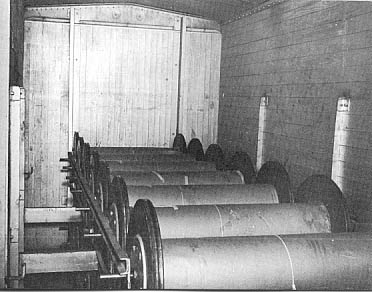
The special construction inside such Southern box cars as the one pictured here is designed to carry so-called "beams" of nylon and rayon. The beams lock in place, thus assuring damage-free shipment. |
 |
American Enka was incorporated with capital supplied by a firm from across the Atlantic Ocean in Holland, Nederlandsche Kunstziidefabriek, N.V. (It is from the "n-k" sound of the initial letters in the parent firm's Dutch name that "Enka" is derived.)
Once described by Business Week magazine as "a giant international textile combine with 17 European affiliate companies," the Dutch firm was 15 years old in 1928 when it incorporated American Enka as a United States subsidiary.
One of the reasons it made the move was because growing American trade protectionism was leading to a decrease in the importation of rayon into the United States, thus cutting away at the profits of many European artificial silk firms.
So the Dutch did as investors of German, Swiss and British capital would soon do. They financed an American subsidiary, incorporated on May 1, 1928.
Then began a nation-wide search for a suitable plant site. More than 50 locations were evaluated, and from these, Asheville stood out.
There were other reasons. The manufacture of rayon is a chemical process, and North Carolina, along with much of the rest of the South, has always been "big" in chemicals. Some of these chemicals -tar, pitch, turpentine -are extracted from trees, a natural resource which the South has in great enough abundance that its furniture and its pulp and paper industries have come in modern times to be among the nation's largest and most productive, as its naval stores industry has been from colonial days. The basic raw material for rayon itself is cellulose, the fibrous heart of trees and other plants. As used in rayon manufacture today, It is a major pulp industry product.
So the 2,000 acres of land in the Hominy Valley were bought in a transaction which the president of the Asheville Real Estate Board said was "on a par with the establishment of the Great Smoky Mountains National Park. ..It is, I believe, the greatest individual thing that has ever happened to this city."
The industry which thus took root is today the country's second largest producer of rayon. American Enka has plants not only at Asheville but also on a 500-acre site at Lowland, Tenn. Both are on Southern Railway. Together, they have an annual capacity of more than 200 million pounds of rayon, rayon staple and nylon. At these two, and at New England and California plants where wire and cable are produced, American Enka distributes to about 6,500 persons an annual payroll in excess of $30 million. The Asheville plant, in numbers of employees, is the largest North Carolina industry west of Charlotte.
It requires enough water each day to supply the needs of a city of 200,000 persons. In the production of its own steam, it uses enough coal -520 tons each day to satisfy the residential needs of 75,000 people. It generates enough electricity to supply 38,000 homes.
Gross plant investment has grown to $150 million as more production facilities have been needed and new product lines added.
The postwar construction of the plant at Lowland, on Southern's Bulls Gap cutoff, was preceded by three expansions at the Asheville plant and was followed by further expansions at both locations in 1950.
In 1953, Enka went into the production of nylon with the construction of a plant at Asheville which already is undergoing is fourth expansion.
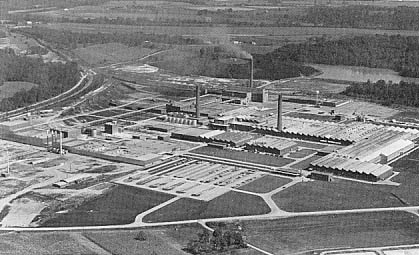
At Lowland, Tenn., Enka's second plant built after World War II. Southern's Bulls Gap cutoff is to the left. |
 |
And, in the meantime, a 75-million-pound rayon staple plant was added to the Lowland properties and the three plants where wire and cable are produced were bought.
The seed of this tremendous growth was $16 million in European capital. But the nurturing forces of growth have been those which first attracted that capital to America, to the South, and to Asheville.
Dutch technicians and workers brought to Asheville to supervise the initial operations of the plant and to teach American labor the skills of rayon manufacture did their jobs well with willing students. They soon were able to turn the plant over to those they had taught and return to their homes in Europe.
The actual management of the firm has long been largely American, and a substantial number of shares of Enka stock are now held by Americans -though the parent Dutch firm still holds 56 per cent of the stock.
But even at that, according to a 1957 article in Business Week, the Dutch parent firm "believes its technical al\d other information exchange with American Enka is more important than the profit from ownership of Enka shares."
The nerve center of this technical and scientific research of American Enka's is a $2 million laboratory built on the Asheville grounds in 1955.
Housing more than 200 scientists and technicians, it is here that quality control is maintained and research conducted on such things as "Tyrex," brand name for a greatly improved tire yarn developed by American Enka and other rayon manufacturers in 1958. It is the cord which is used in original-equipment tires on virtually all passenger cars being built today. So big is this tire cord market -worth some $300 million annually - that Enka customarily counts on it for an important share of its business.
Enka rayon and nylon, of course, find dozens of other uses. In clothing of every description; in draperies, carpets and upholstery fabrics; industrially, in high-pressure hosing, rope, power and conveyor belting; and back to automobiles for fan belts, convertible tops and interiors.
Even though American Enka has so large a stake in the rubber tire, however, it is upon the Hanged steel wheel that its productive strength relies.
The Asheville plant was built within a few hundred yards of Southern's Murphy Branch line, from which there are now nine service tracks entering Enka property. Construction of the Lowland plant was planned to take full advantage of Southern's Bulls Gap cutoff. American Enka was the first industry to locate along that portion of Southern in East Tennessee.
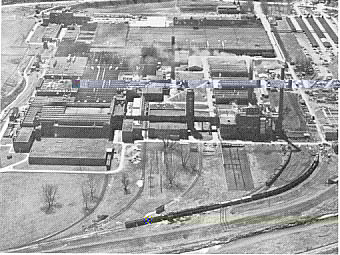
The American Enka Corporation's plant at Asheville, N. C. (far right) .In the foreground, paralleling the road, is Southern's "Murphy Branch." The Southern tracks which serve the Asheville facility can be seen between the Murphy Branch and the plant. |
 |
It is over the cutoff and the Murphy Branch that American Enka receives from throughout the Southeast its raw materials -caprolactam ( a derivative of petroleum or of the tars produced by the distillation of bituminous coal) , which is the basic raw material for nylon, and wood pulp, sulfuric acid, caustic soda and carbon disulfide for rayon.
Just as these raw materials are received for the most part from sources within the Southeast, so too does American Enka's distribution pattern correspond largely with the area served by Southern -from 70 to 80 per cent of its finished rayon and nylon have been distributed in the Southeast in recent years.
Important other shipments include "glauber salt" and other varieties of sodium sulfate, by-products of rayon manufacture which Enka ships via Southern from both Lowland and Asheville to makers of detergents and to paper mills.
And American Enka's huge coal needs are met by shipments received via Southern from southwest Virginia and eastern Kentucky.
In a variety of ways, American Enka is demonstrating that its faith in the men and resources of the South still holds.
It is a widely popular concept in the business world, for instance, that corporate headquarters should -no, must -be located in a northern commercial center Chicago, Philadelphia, New York, or some other.
Not so with American Enka. A year ago it packed its files in New York City, removed its corporate headquarters and relocated in modern, spacious quarters on the landscaped grounds of the Asheville plant: (Still in New York are a district sales office and advertising and merchandising departments. )
In another demonstration that American Enka retains its faith, the expansion which is now going on at its nylon facility at Asheville will increase capacity by 70 percent and will provide several hundred more jobs. I, "
The circles are still radiating outwards.
As is the case with Southern, American Enka has been inspired by the fiercely competitive conditions of its industry to make available the best of whatever is wanted at the lowest possible cost.
And both Southern and Enka are determined to constantly re-create conditions similar to those from which their success came: Energy, ability, farsightedness, the determined courage of private capital turned intelligently to private enterprise.
It is in its own approach to this mission that American Enka assumes a stature larger than that of being merely an economic member of the community.
There is the Enka Foundation, a charitable trust created in 1952. The Foundation has provided such things as funds for the college scholarships which individuals may need in order to prepare themselves for their own futures and that of their country .In addition, American Enka supports a program of formal college education in which its own employees may participate in their spare time.
Perhaps one key to understanding the importance of American Enka as an industry in the South lies in remembering that the firm manufactures no product which is placed on the consumer market in the same form as that in which it leaves Enka.
Its rayon and nylon yarns are, in a sense, '1iving products" which string out from Enka to involve themselves in the warp and woof of industrial processes and consumer purchases across the country. September 23, 1928, was an important day in Asheville and western North Carolina. Few, if any, who read their newspapers that day could have realized the full import of what was to be.