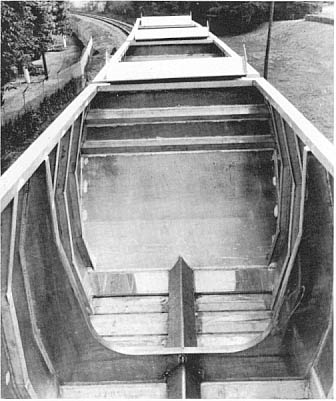
Interior view of the all-aluminum car body and center sill. |
 |
"The use of conventional low-capacity railroad hop- per cars in unit train service is wasteful. For one thing, such cars have a loaded to empty car weight ratio of only about 2.6 to I. That's too much dead weight to haul around when you are seeking to work on close margins of profit. Most of these cars are of 50 and 70 tons capacity, too small for truly economical volume movements. Most do not lend themselves to rapid load- ing and unloading procedures. There are still other disadvantages that SOUTHERN 100 is intended to overcome," President D. W. Brosnan of Southern said during a talk made in Middletown, Ohio, when Aeronca Manufacturing Corporation displayed the result of a joint research and development project between the two companies.
Interior view of the all-aluminum car body and center sill. |
|
Mr. Brosnan reviewed some of the efforts already made by Southern to lower transportation costs by building larger and lighter car for hauling coal. He continued, "Southern still feels there is more that can- and must-be done to lower operating costs of unit train service. That's why we welcomed the chance to work with Aeronca, discarding traditional practices in freight car design and construction with a view to introducing something entirely new. The car we have seen today has a loaded to empty weight ratio of about 7 to I, far, far greater than the 2.6 to 1 of conventional hopper cars. That's really battling waste in the effort to add to useful productivity. ...
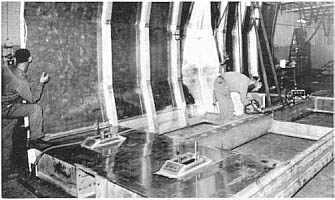
A view during construction of the all-welded car. |
 |
"The keen pace of today's competition demands that we reduce to a minimum the wasteful practices that are traditionally imbedded in railroading. Ferreting out such things is a most rewarding occupation. We're busy at it on Southern and intend to keep busy along these lines.
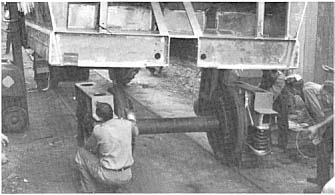
Positioning one of the single-axle car trucks. |
 |
Jobs follow the freight