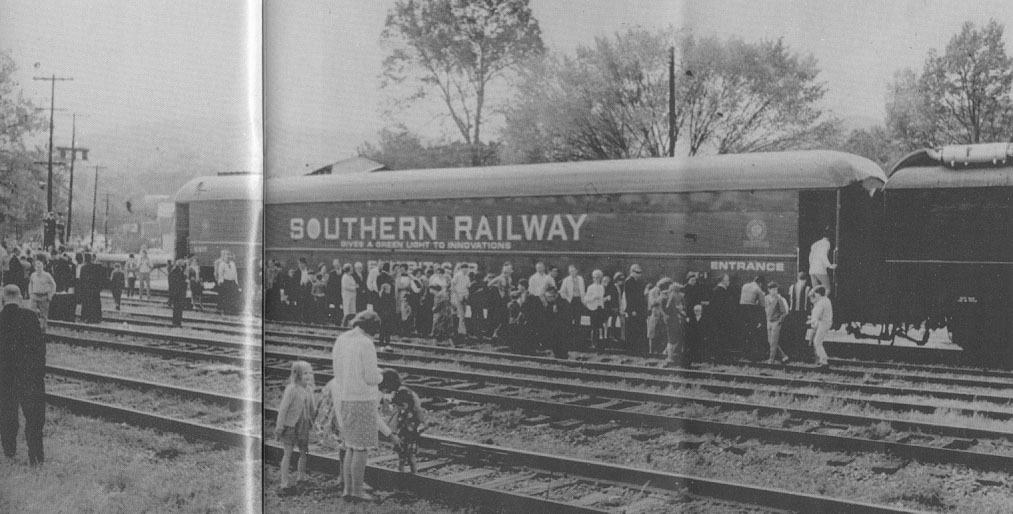
Guests at the 75th Anniversary Steamorama in Anniston, Ala., trooped through the Exhibit Car by the hundreds to enjoy this showcase of Southern's progress. |
 |
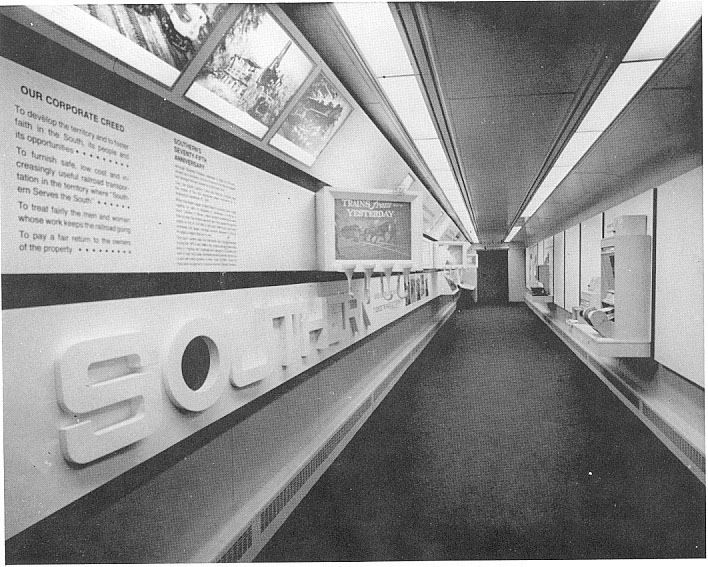
To bring the story of a modern railroad directly to the people who depend on its service, Southern Railway has designed and built a new Exhibit Car that depicts in photographs, models, dioramas and slide presentations the railway's development as a customer oriented, innovative transportation system.
" A green light to innovations" is the display theme, emblazoned in gold lettering on the car's sylvan green exterior and carried out inside the car with exhibits highlighting three major aspects of Southern's story.
Guests at the 75th Anniversary Steamorama in Anniston, Ala., trooped through the Exhibit Car by the hundreds to enjoy this showcase of Southern's progress. |
|
First shown to the public in Anniston, Ala., in November at the Steamorama celebration, the car intrigued hundreds of visitors with its colorful panorama of Southern's past and present and its reach toward the future.
Three sound-and-slide presentations, each projected on an eye-level screen equipped with personal "Headphones" for individual listening, set the stage for the three display sections.
"Trains From Yesterday" deals with the development of railroads and Southern's growth from a number of small lines, through the post-Civil War trend toward combined systems to the South-wide network of rails that is today's System.
"Technology-the Quiet Revolution" details the advances in motive power, communications, computer information processing, operations control, yard modernization, track maintenance, market research and car design that have helped Southern come into its own as a diversified, customer-oriented transportation system.
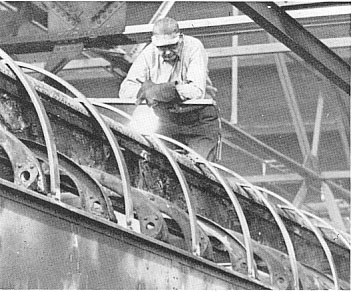
Working on the shell of the Exhibit Car at Hayne Car Shop. |
 |
"Strengthening the Modern South" tells what Southern's progress continues to mean to the economic growth of the territory the railroad serves. Describing the combined effect of the railway's industrial development work and its creation of an effective transportation service for business, industry and agriculture, the presentation shows the results in terms of industrial and agribusiness expansion.
The accompanying displays use lighted transparencies, color photographs, maps, charts, three-dimensional dioramas and working models to illustrate various aspects of rail progress.
Scale models of many of Southern's new freight cars introduce visitors to the many varieties of car design that shape railroad service to customer needs. One lighted diorama shows the process of laying welded rail for better, smoother and safer track. Another depicts one of the crane-transfers used in Southern's rail-highway service.
Southern's Exhibit Car offers the guest things to do as well as to see in becoming acquainted with the modern railway. A large-scale map showing the railway's microwave communications network has a wall telephone near it. A visitor can dial the car locator action of the control center in Atlanta and test Southern's computer-based information network by asking for the instant location of any freight car on Southern's lines.
Clean lines and uncluttered space are features of the Exhibit Car. The first slide presentation and display area puts Southern's growth in historical perspective. |
 |
Nearby is a working model combination of an LDX transmitter and receiver of the kind Southern uses to reproduce waybills from yards and terminals hundreds of miles away almost instantaneously at the computer center in Atlanta. A visitor can place a waybill in the transmitter model and see the simulation of its instant reproduction on the LDX receiver in Atlanta.
In recognition of Southern's 75th anniversary as a company, a special panel calls graphic attention to the events at home and abroad that made news in 1894, the year of Southern's corporate birth.
Most popular display with the youngsters who have visited the car is the working demonstration model of one of the railway's hot box detectors. It consists of a heat-sensing device. built into a short length of model track on which a model flat car can be pushed back and forth. The heat-sensor is connected to an actual detector instrument in which a pen on a moving graph shows by its movement whether the temperature of each of the model car's journal boxes is normal or overheated. On the graph, one journal shows as too hot and a touch of the fingertip on the wheel journal indicated shows quickly that the detector is reporting this condition correctly.
Most popular exhibit with the youngsters who visited the car at Anniston was this do-it-yourself demonstration of Southern's hot box detectors. So popular did it prove that one of the necessary refinements added as a result was the Plexiglass cover over the face of the detector Instrument. All the buttons, knobs and dials proved too much of a temptation for young visitors. 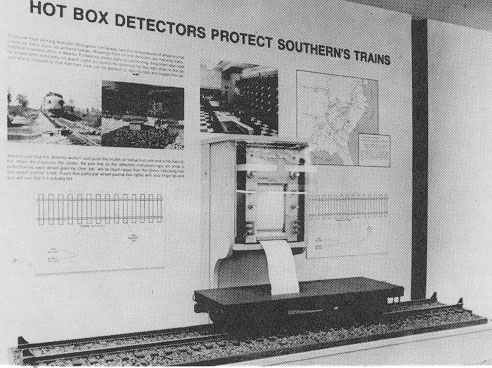 |
The car is also equipped with a pull-down screen and has storage areas for a dozen folding chairs and a projector, so that motion pictures can be shown to small groups.
Southern's decision to build a display car of this kind grew out of the realization that much of a railway's innovation and modernization goes on behind the scenes, where not even all railway people have an opportunity to see it, much less the public. Concentrating the essence of a 10,000 mile railway in an exhibit car that could go wherever the rails go seemed the most practical way of bringing about a meeting between a railway system that is busy applying advanced technology to the transportation business and the people who stand to benefit from its progress.
Lighted transparencies and dioramas (ribbon rail installation, center, and rail highway transfer, top right) help introduce visitors to Southem's advanced technology. 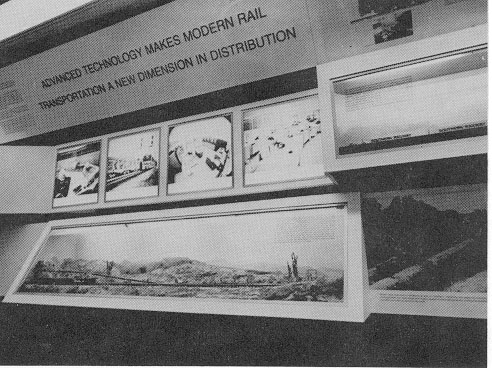 |
Starting with the shell of an old Pullman car, Southern rebuilt it completely at Hayne Shop in Spartanburg, S.C. Windowed sides were replaced with solid construction including strips of steel along the inner wall frame to provide solid mounting for the exhibits. New lighting, heating and air-conditioning were installed, including - self-contained heating system. A generator and battery bank were provided to enable operating for limited periods without an outside power source. Extensive wiring circuits and outlets were installed for lighting the displays. New trucks were installed and end-of-car cushioning added to the underframe. Final preparation steps included interior paneling and painting and the paint finish and lettering for the car's exterior surface.
Meanwhile, Art Designers, a display firm in Alexandria, Va., worked with blueprints, sketches and measurements to design the size and shape of exhibits and devise mountings that would carry the exhibit material safely through the car's handling in local freight as well as passenger trains. George Snyder, Southern's road foreman of engines at Chattanooga and a skilled model maker, designed and constructed the two display models that show the workings of Southern's LDX and hotbox detection systems.
Scale models of some of Southern's customer-designed freight cars, including the pace-setting "Big John" and "Silversides," highlight the marketing approach of tailoring equipment and service to the customer's needs. 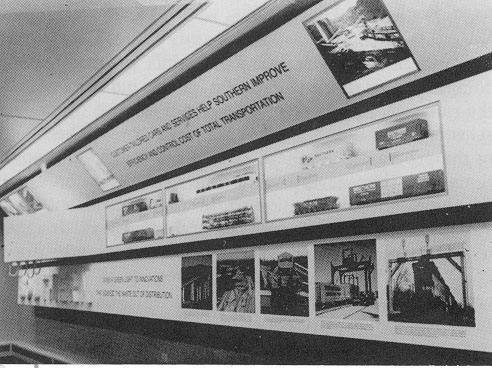 |
On completion of construction and painting at Hayne, the car was brought to Alexandria for installation of exhibits. Using a pale green and white interior as a background for the colorful and carefully placed displays, the designers worked to create a feeling of openness and space in what is essentially a narrow compartment. Outdoor-indoor carpeting in a shade of dark green was used for floor covering to add to visitor comfort and reduce the noise level when a number of people are in the car . In addition to helping share Southern's story with hundreds of rail-fans and visitors who thronged to the Steamorama meeting of the three steam trains, the trip to Anniston served as a valuable "shakedown cruise."
Principally, it helped Southern determine the riding quality of the car and safe mounting of exhibits (which proved good on both counts); measure the effectiveness of the presentations in terms of, visitor reaction (uniformly favorable); and test the ease or difficulty of moving large numbers of people through the car in a short time, if necessary (nearly a thousand in five hours without real difficulty).
From the past to1he present is only a step in Southern's Exhibit Car. Just inside the entrance is this map, telephone and working model display of Southern's microwave communications network and system-wide information gathering by LDX. 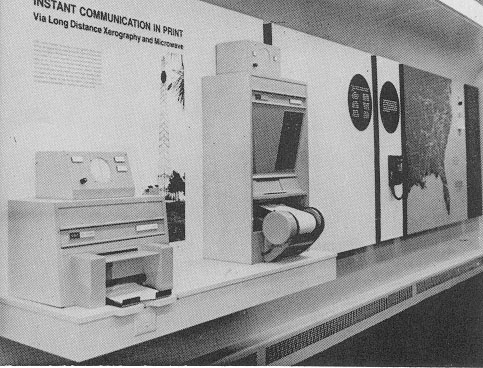 |
Actual experience with the Exhibit Car did disclose several useful challenges and refinements in the exhibit displays. One other change has been made that gives an insight into, the reason for the flexibility of changing display subjects that has been engineered into the car. Already one of the freight car scale models has been replaced with a newer version.
Southern foresees a variety of uses for the Exhibit Car in giving employees, shippers, students and the public generally a vivid look at Southern's progress. Requests for exhibit car appearances are already being received, and it is expected that the car will spend some time in South Carolina next year during that state's Tricentennial Celebration.