LOCOMOTIVES POWERING the "Southern Crescent" once again wear Southern's green and gold, with a distinctive monogram identifying the railway's finest passenger train.
When Southern recently completed repainting the 17 diesel units assigned to the "Southern Crescent" and emblazoning the train's name in gold across the noses of the diesels, the railway was recognizing a tradition of luxury passenger travel that's almost a century old.
A decade after the Civil War, Southern's predecessor, the Richmond and Danville Railroad Company, established the "Piedmont Air Line Route." This connected the Northeast with Atlanta and New Orleans both via Richmond and via Southern's present route through Charlottesville, Va., and Lynchburg, Va. The "Southern Express" and the "Southern Mail" operated over these routes, on an advertised time of 57 hours and 40 minutes, including a change at Atlanta.
Today's "Southern Crescent" is the lineal descendant of the "Washington and Southwestern Vestibuled Limited," inaugurated in January, 1891, by the Richmond and Danville Railroad along the "Piedmont Air Line Route." This Washington-Atlanta train was soon nicknamed the "Vestibule" because it was the first all-year train with vestibuled equipment operating in the South.
The brochure announcing the train hailed it as "a service second to none in completeness and elegance of detail ...providing all the latest and best facilities for the comfort and enjoyment of its patrons." And the "Vestibule" lived up to its billing. Drawing room and stateroom sleeping cars, dining cars, smoking and library cars and observation cars embodied the latest, most luxurious designs. They were gas lighted throughout and equipped with hot and cold running water. The vestibuled platforms proved an interesting novelty. Many passengers spent considerable time walking from one car to another just to enjoy the unusual experience of being able to do so without having their hats blown away.
Soon the Washington-Atlanta schedule expanded to include a through Pullman to New Orleans via Montgomery and Mobile, Ala., over the rails of the Atlanta & West Point, the Western Railway of Alabama, and the Louisville and Nashville Railroad. New York was brought into the schedule, via a connection with the Pennsylvania Railroad's "Congressional Limited." Scheduled time for the New York-New Orleans run was advertised as a "40-hour, unprecedented" trip. Because of the popularity of this through service, the "Washington and Southwestern Vestibuled Limited" became a solid train of through cars between New York and New Orleans. It carried the first dining cars to operate between those two cities.
After operating 15 years as a solid train, in 1906 the train was renamed the "New York and New Orleans Limited" and re-equipped with new observation and club cars. It became "a year-around exclusive Pullman car train." Coast-to-coast passengers (in connection with the Southern Pacific Sunset Express via New Orleans) were actively solicited.
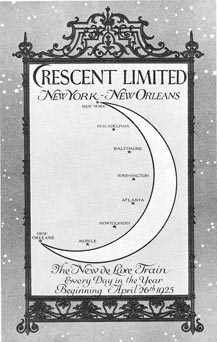
A new service was begun in 1925 and the train was renamed the "Crescent Limited." On April 26, with the clock of the St. Louis Cathedral, New Orleans, striking ten, a graceful Louisville and Nashville Pacific Class K-2, of pre-World War I vintage, pulled out of Canal Street station on her maiden trip to New York City. This new deluxe, extra fare all-Pullman consist ran solidly between New Orleans and New York over the L&N, the West Point Route, the Southern and Pennsylvania railroads.
The "Crescent Limited" had luxurious Pullman equipment of the latest design, arranged to provide optimum comfort and convenience. The club car was forward with movable easy chairs. Passengers lounged, smoked and chatted, with a valet-porter always nearby to assure comfort.
The observation car served as a salon for social gatherings. There was the usual large smoking room for the men, and spacious dressing rooms for ladies and children.
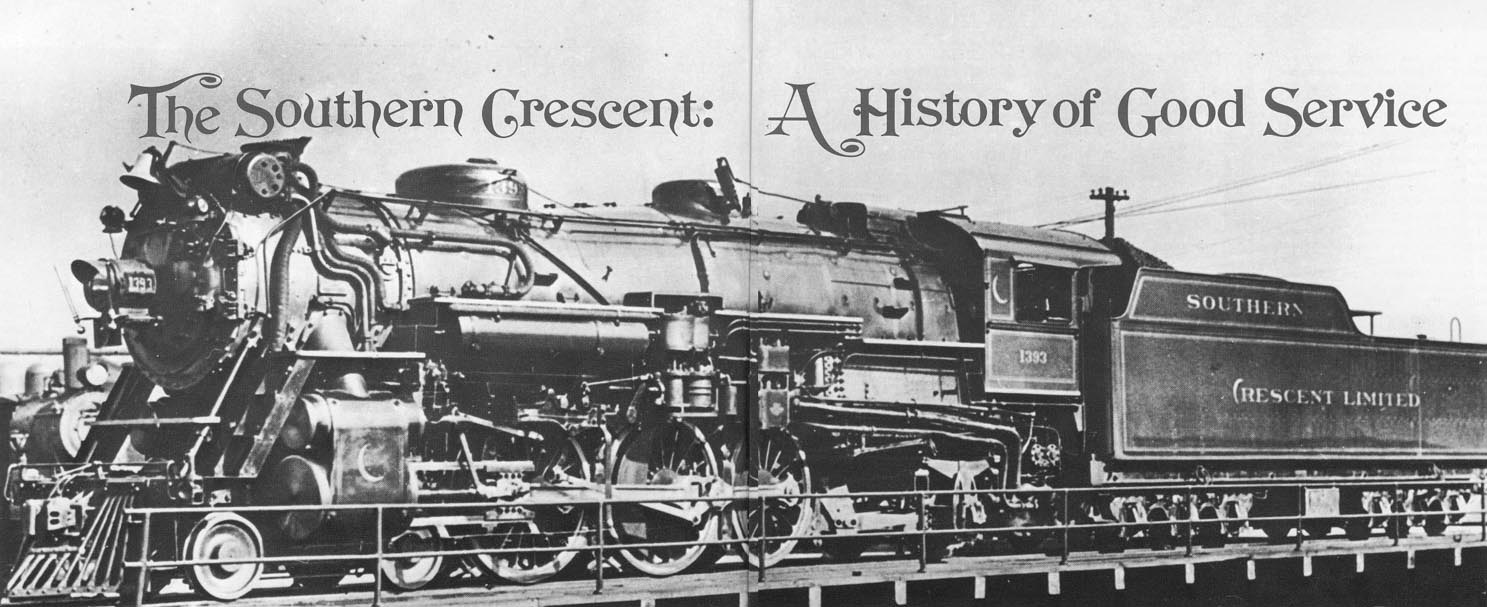
After July of 1926, the "Crescent Limited" was pulled between Atlanta and Washington by Southern's new green and gold heavy Pacific locomotives, each decorated with a gold crescent on the cylinder and the train's name emblazoned on the tender. Locomotive fanciers agree that those handsome iron horses rank among the most beautiful of all time.
Handsome electrically illuminated tail signs were installed on the train's new observation sleepers. Rectangular in shape, the signs had a dark blue background, showing a field of stars and the name "Crescent Limited" in white.
The idea of painting Southern locomotives a beautiful green with gleaming gold accent stripes did not come from an advertising man. It came from Fairfax Harrison, president of Southern at the time. During a visit to England, he was favorably impressed by the popularity and beauty of green as a locomotive color. He particularly admired the medium shade of green used on the Southern (of England) and the lighter apple green of the London and North Eastern.
An announcement of the "Crescent's" debut in 1925. |
 |
Southern Railway announced in 1929 that its first "train of luxury" was to begin life anew with brand-new equipment. Along with new Pullmans, cars built especially for the "Crescent Limited" four years earlier were completely refinished. What was "all new" was the distinctive exterior finish. Two shades of green adorned the luxury cars, each one lettered "Crescent Limited" in gold leaf along the upper panels. Pullman cars were named for distinguished sons of the seven states of the South through which the train ran.
During the Great Depression, the name "Crescent Limited" along with the extra fare and apple green color train-vanished from the timetable. Southern Railway thought it best to "soft-pedal" its expensive headliner during those severe times.
In 1934 the name "Crescent Limited" was officially discontinued. An Associated Press dispatch written by Dillon Graham of New Orleans amply summed up the sentiments surrounding the last trip.
Mr. Graham said:
"The 'Crescent Limited,' crack green-coach passenger train that for years has raced through the South on its flight from Broadway to Noo A'Leens, makes its last run Wednesday- choosing retirement rather than the commonness of carrying day coaches as just another transport.
"Never has this last of the extra- fare trains of Dixie linked a day coach to its string of all-Pullman cars. For years reservations on this deluxe liner of the rails were almost at a premium. Patronage has fallen off in recent years and this has forced the removal of the extra fare and the addition of day coaches.
"Within every railroader there is sentiment and romance attached to trains. With the 'Crescent's' proud history, it would have been less majestic to ask her to take to the roadbeds as just another train-and not the accepted queen of the line. So the fast limited, with its famed identifying green-colored cars is being honorably withdrawn from service."
The former "Crescent Limited" became known as "Nos. 37 and 38," and coaches were added to the consist. But in 1938 the train was renamed the "Crescent" and air-conditioned coach equipment, the first on the Southern, was added. The coaches added to the former Nos. 37 and 38 were removed to once again make the train all-Pullman.
The next step in the train's history came in 1941 with the substitution of diesel power for steam between Atlanta and Washington. Strikingly attired in green and white, the new 4,000 h.p. General Motors units hauled the train to Washington, where Pennsylvania GGI electrics continued the trip to New York.
At the same time, Southern inaugurated an all-coach diesel-powered streamliner, the "Southerner," between New York and New Orleans over an all-Southern Railway route via Birmingham and Anniston, Ala. (This train was three hours faster between New York and New Orleans. Today's "Southern Crescent" operates over this route.)
With the addition of the modern diesel engine, the "Crescent" continued to play an important role in the history of the nation. During World War II, the train handled wartime traffic from 49 military posts located along its lines.
Soon after the end of the war, plans were completed for the streamlining of the train. Orders for lightweight equipment to "make over" the "Crescent" were placed with car manufacturers in 1946, as part of an $11,500,000 order to streamline and renew four Southern Railway trains. The other trains were the "Southerner," the "Tennessean," and the "Royal Palm."
In 1949, a shining stainless steel "Crescent" was delivered by Pullman Standard. This new streamliner provided the latest in modern, comfortable, safe all-weather transportation. A worthy successor to its famed predecessors, the train offered accommodations to meet every travel need. Five kinds of private rooms were available -roomettes; bedrooms (singly and en suite) ; drawing rooms, the only master room in the South, complete with private shower and radio; and deluxe reclining-seat coaches were operated between Atlanta and New Orleans over the Atlanta and West Point and Louisville and Nashville lines.
Passengers admired the new streamlined, stainless steel "Crescent" and enjoyed the soft upholstery, thick carpets, and subdued colors inside. The new "Crescent" ran on a fast, snappy "one night out" schedule.
Unfortunately, however, with passenger traffic continually being eroded by the automobiles and airlines, the years after 1950 saw consolidation of many passenger routes. In 1956 the "Crescent" (trains Nos. 37 and 38) and the "Augusta Special" (trains Nos. 31 and 32) were consolidated between Washington and Charlotte, transferring stops from Nos. 31 and 32 to Nos. 37 and 38, on that part of the run.
In 1970 the "Crescent," which had operated as train Nos. 37 and 38, began to operate as Nos. 1 and 2. The train was consolidated with the "Southerner" and renamed the "Southern Crescent." The train offers dining car service between Washington and New Orleans and reserved reclining seat coaches and sleeping cars between New York and New Orleans.
In cooperation with Amtrak, the "Southern Crescent" now has as its northern terminal Boston, Mass. Train No.1 southbound leaves Washington at 7 p.m. and northbound Train No.2 leaves Birmingham, Ala., at 2: 10 p.m. and Atlanta, Ga., at 7 p.m. Train No. 2's tri-weekly departure from New Orleans, La., is at 7 a.m.
Coach passengers between Boston and New Orleans and intermediate points on the route need not change trains or cars for the entire trip. A tri-weekly transcontinental New York- Los Angeles sleeping car line has become a Boston-Los Angeles sleeper. Sleeping car passengers can travel coast-to-coast between Boston and Los Angeles without changing cars, occupying the same accommodations for the entire trip. Through passengers are treated to the delights of New Orleans during a one-night stopover. The train arrives in New Orleans at 7:30 p.m. and departs for Los Angeles at 1 p.m. the next day. During this time passengers can use the train's accommodations as a "hotel."
Since 1958 the engines of Southern's premier train had been black and white. But early in 1972, the president of Southern, W. Graham Claytor, Jr., had the engines repainted in the green and gold colors of one of their proud ancestors. This highlights the latest chapter in a story of fine passenger service that began with the old "Piedmont Air Line Route" almost a century ago.